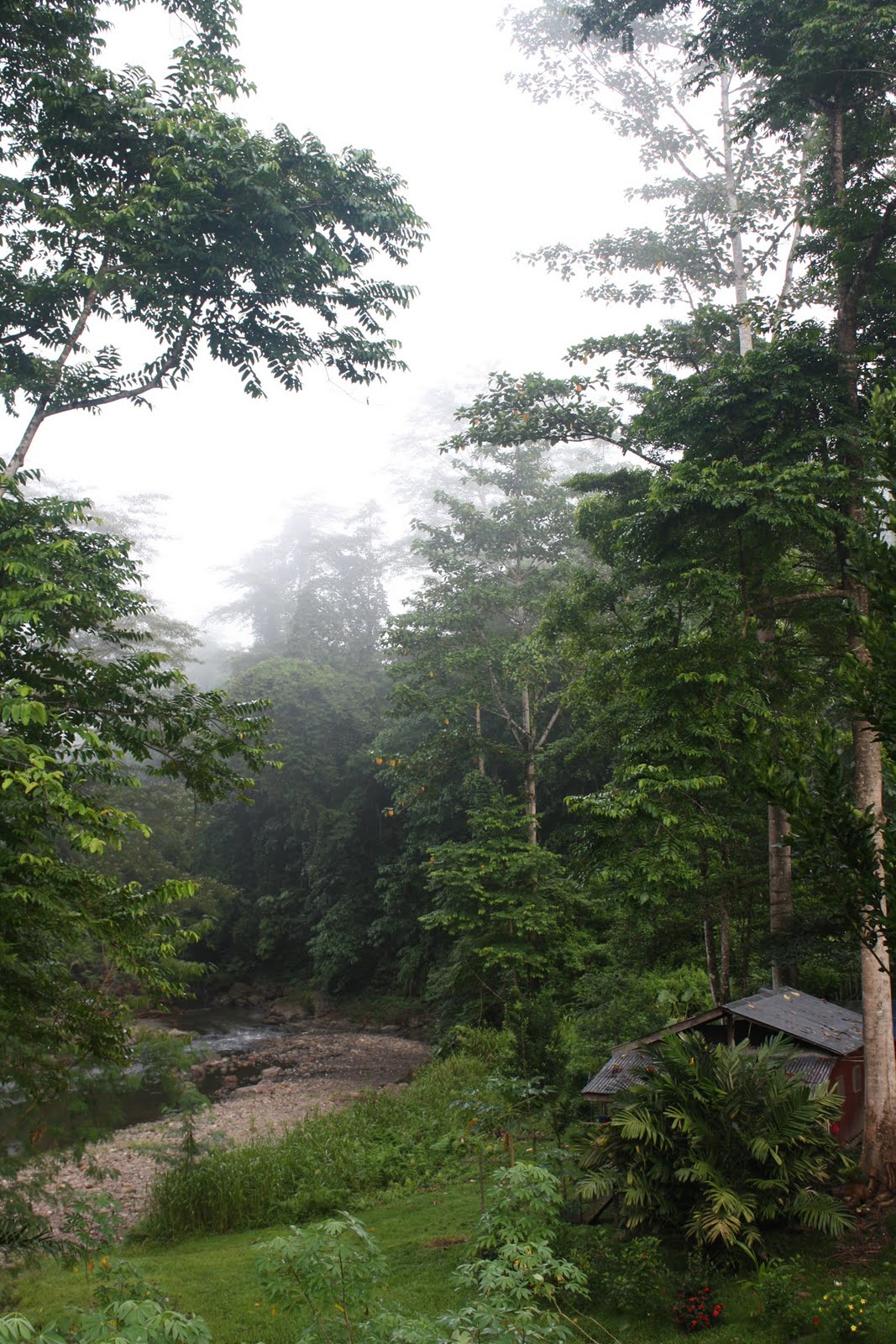
Today is a rest day, and we're spending it at the Borneo Rainforest Lodge. The lodge is in the Danum Valley, in the conservation area, so it's all primary growth forest. This morning we started with a canopy walk, followed by a 2 1/2 hour hike. The forest is quite different from the degraded (twice-logged) forest at Malua. The tree canopy is much higher, dominated by primary-growth trees, especially dipterocarps.
I can't begin to describe all the bird species here (besides, I can't identify most of them). The most famous birds in the forest are probably the various types of hornbills. The larger ones have a wing span of about 2 m, and when they fly in a group and flap their wings it sounds like an approaching train. Very fascinating birds.
The most significant thing I've learned here is how "in balance" everything is when there is no un-natural interference. Because there's a balance of species, including natural predators, there isn't an overabundance of any species.
Glen gave a short tutorial in the afternoon, about deforestation. Most of the harvestable timber in Malaysia has been harvested; and most available land (that can be converted) has been converted to oil palm plantations. The remaining available land in Borneo is in Indonesia. So Indonesia has the only opportunity to "do it right" in terms of sustainable logging. They have the opportunity to retain patches of primary forest - questions include "how large?" and "how many patches?"
Glen gave a short tutorial in the afternoon, about deforestation. Most of the harvestable timber in Malaysia has been harvested; and most available land (that can be converted) has been converted to oil palm plantations. The remaining available land in Borneo is in Indonesia. So Indonesia has the only opportunity to "do it right" in terms of sustainable logging. They have the opportunity to retain patches of primary forest - questions include "how large?" and "how many patches?"


The afternoon rainshowers - nearly every day, straight down (not much wind in the rainforest because of the high tree canopy), lasting about an hour.

Lizards are everywhere - it's their home, we're the visitors